
So, picture this: It’s April 1815, and a farmer on the island of Sumbawa is tending his crops. Suddenly, the ground doesn’t just shake—it roars. A column of ash shoots up so high it blots out the sun for three days. He has no idea he’s witnessing the most powerful volcanic eruption in recorded history. That’s the moment Mount Tambora decided to rewrite the global climate—and our story begins.
1. It was the loudest sound ever recorded
Imagine the loudest rock concert you’ve ever been to—now multiply that by a billion. The explosion was heard 2,000 kilometers away, on Sumatra. That’s like someone in New York hearing a blast in Denver. Insane, right?
2. It created a “year without a summer”
The ash cloud blocked sunlight so effectively that 1816 became known as the “Year Without a Summer.” Snow fell in June in New England, and crops failed across Europe. Mary Shelley was stuck inside during that gloomy Swiss summer—and wrote Frankenstein. Thanks, Tambora?
Must Read
3. The eruption was a VEI-7—the highest in 1,300 years
Volcanologists rank explosions on the Volcanic Explosivity Index (VEI). Tambora scored a 7—the only one that big since ancient times. For context, Mount St. Helens was a paltry VEI-5. Tambora basically said, “Hold my magma.”
4. It collapsed its own mountain
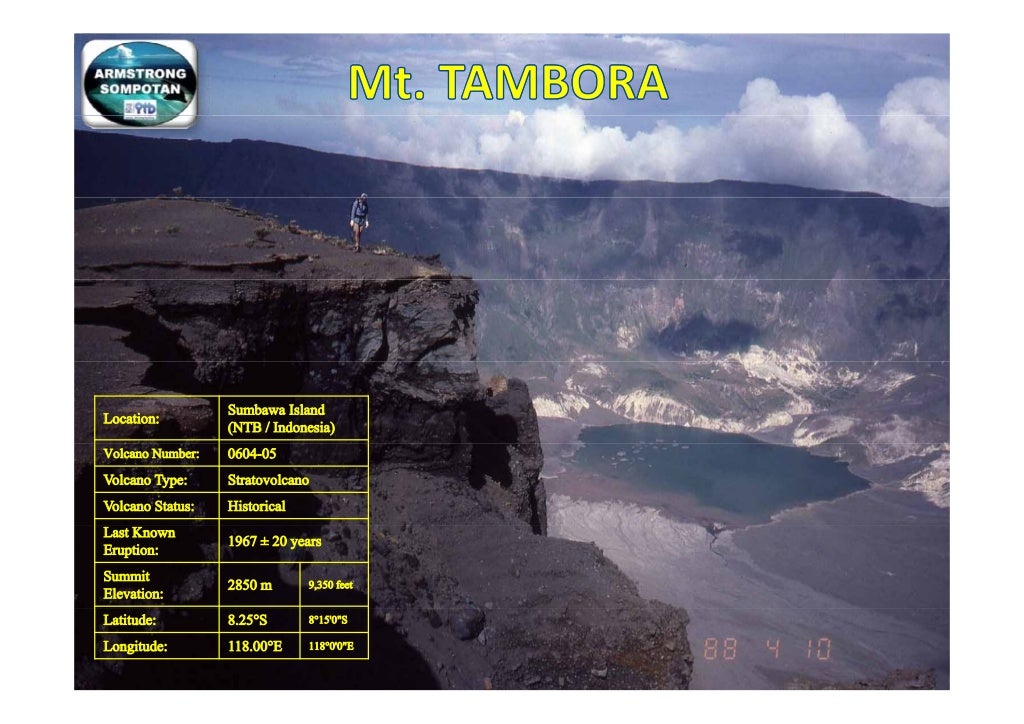
Before 1815, Tambora stood about 4,300 meters tall. After the blast? Only 2,850 meters. That’s a whole kilometer of mountain gone. It literally blew its top off, leaving a massive caldera 6 kilometers wide. Talk about a bad hair day.
5. The eruption killed at least 71,000 people
Directly, about 10,000 died from pyroclastic flows and ash. But the real killer was the famine and disease that followed. Crops in Europe, Asia, and America failed. In some places, people resorted to eating clay. It’s a grim reminder that volcanoes don’t just destroy—they starve.
6. It turned the sky into a painting
Sunsets around the world turned blood-red and fiery orange for months because of the ash. Artists like J.M.W. Turner painted those surreal skies—but they weren’t being artistic; they were documenting reality. Nature does drama better than any filter.
 Mount Tambora Eruption Facts – Tambora Volcano History – IVMR
7. The “Lost Kingdom of Tambora” was buried alive
A whole civilization—the Tamboran kingdom—was wiped out under ash that stayed frozen in time. Archaeologists later found a village preserved like Pompeii, complete with a family inside a house. They didn’t even have time to run. It’s haunting, but also a time capsule.
8. Tambora is still active—and sleeping
Don’t get too comfortable. The volcano has rumbled a few times since 1815, including a small eruption in 2017. Seismologists keep an eye on it because when a VEI-7 wakes up, you want to be very far away. You know, just in case.
9. The eruption affected weather patterns for years
The sulfur dioxide in the stratosphere cooled the planet by about 0.5°C. That doesn’t sound like much, but it shifted monsoons, caused droughts in India, and even triggered a cholera pandemic. One mountain, one boom, and the whole planet sneezes.
10. It’s a must-see for adventurous hikers—if you dare
Today, you can trek Mount Tambora through dense jungle to the rim of the caldera. The view is breathtaking—literally, because the altitude is 2,850 meters. Just remember, you’re standing on the edge of a monster that once changed the world. Snap a selfie, but maybe don’t camp overnight.
So there you have it—Tambora: the volcano that made global headlines before global headlines existed. Next time you complain about a rainy summer, just be grateful it’s not 1816. And if you ever visit Indonesia, give that mountain a respectful nod. It earned it.