
Let’s talk about aluminum foil. Yes, that crinkly, shiny stuff you use to wrap leftovers. You probably think it’s just a kitchen servant. But guess what? It’s a superstar of science.
The big question: Is aluminum foil a good conductor? The short answer is a loud, enthusiastic YES. It’s so good, it’s almost embarrassing.
Aluminum is a metal, and metals love to pass around electrons. Think of electrons as tiny, hyperactive kids on a sugar rush. Aluminum foil gives them a perfect playground to zoom around in.
Must Read
Why It’s So Good at the Job
Aluminum is actually better than many other metals at conducting electricity on a per-weight basis. It’s lighter than copper but almost as effective. That’s why power lines use aluminum, not heavy copper.
Your roll of foil has a secret life. It’s a wire in disguise. You could actually complete a simple circuit with it. Just tape two batteries and an LED bulb to a strip of foil. Boom. Light.
But here’s the funny twist. Aluminum foil is a good conductor only if it’s clean and shiny. If it’s covered in a thick layer of sauce or oxidation, it acts like a grumpy old man. It slows the electrons down.
The Quirky Science of Crinkles
Did you know that crinkling the foil changes its conductivity? Yes. A smooth, flat sheet is a superhighway. A crumpled ball is a traffic jam.
That’s because electricity takes the path of least resistance. When you crinkle foil, you create tiny air gaps and folds. The electrons have to take a detour through narrow bridges. It’s like trying to run through a house with too many doors.
 Is Aluminum Foil a Good Conductor of Electricity
Fun fact: You can use this to make a simple pressure sensor. Press down on a crumpled piece of foil between two wires. The harder you press, the more connections form, and the better it conducts. It’s like a squishy switch.
A Warning from the Kitchen
Never, ever put aluminum foil in the microwave. Never. This is not a myth. It will cause sparks, fire, and possibly a small explosion. The foil acts like an antenna for the microwaves.
But why? Because it’s too good a conductor. The high-voltage microwaves create huge currents in the thin metal. The metal gets hot instantly and arcs like a tiny lightning storm. Your leftover pizza will not appreciate the show.
However, you can use foil safely in a low-voltage circuit. Try this: take a 9-volt battery and touch it to a piece of foil. You’ll feel it get warm. That’s resistance converting electricity into heat. It’s a miniature heater!
The Tin Foil Hat Myth
Let’s address the elephant in the room. The tin foil hat. People wear it to block mind control rays. Does it work?
Scientifically? No. Aluminum foil is a conductor, not a magnetic shield for brain waves. In fact, if you wear a foil hat, you might amplify certain radio frequencies. You’d hear more static, not less.
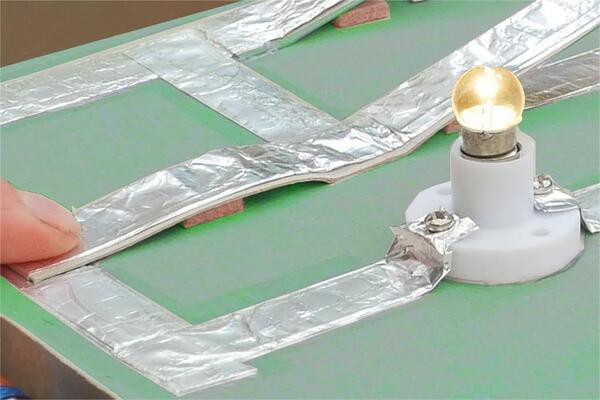 Why does aluminum foil conduct electricity? - Henan Huawei Aluminum Co
But it does block radio waves if you wrap a device completely. That’s why spies use foil-lined bags for their phones. It creates a Faraday cage. So your hat blocks cell signals, not government thoughts. Disappointing, right?
Why This is Just Fun
Think about it. You have a roll of electrical magic sitting in your drawer. It costs pennies. It’s bendy, shiny, and loud. You can use it to learn physics, make a battery, or spy on your cat’s Wi-Fi habits.
Aluminum foil is a conductor that likes to party. It’s energetic. It’s versatile. It’s the life of the science fair.
And here’s a bonus quirky fact. Aluminum foil reflects 97% of radiant heat. That’s why you wrap a baked potato in it. The foil bounces the heat back into the spud, cooking it faster. It’s a heat mirror.
So next time you rip off a sheet, give it a salute. That crinkly thing is a hero. It conducts electricity, deflects heat, and prevents your sandwich from getting soggy. Not bad for a few cents.
Now go ahead. Grab a piece. Touch it to a battery. Watch an LED glow. Become the mad scientist of your kitchen. Just don’t microwave it. Seriously. Don’t.