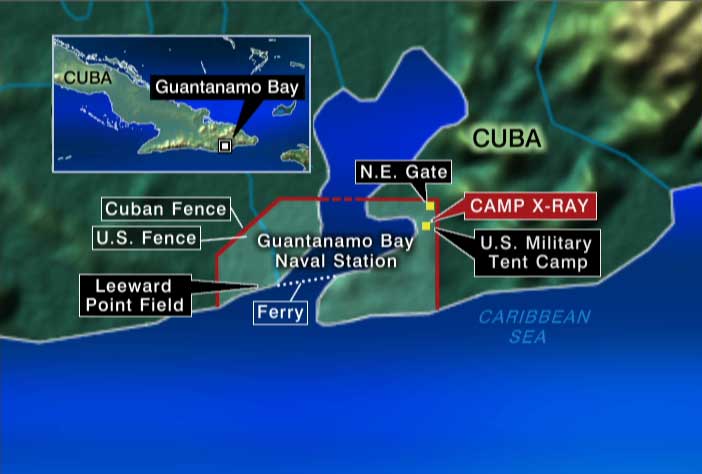
So, I was at a backyard barbecue last weekend—a classic American scene with burgers, potato salad, and someone’s uncle arguing about taxes. Out of nowhere, a buddy of mine squints and says, “So, Guantanamo Bay… is that technically ours, like a part of the U.S.?” The question hung in the air, right between a hot dog and a splash of ketchup. It’s one of those things that sounds obvious until you actually try to answer it. And honestly, the answer is way more twisted than a pretzel—or that uncle’s logic.
Let’s rewind the clock a bit. Guantanamo Bay is a bay on the southeastern coast of Cuba. The U.S. has been renting it—yes, renting—since 1903. We signed a lease with Cuba, paying a pittance (initially $2,000 in gold coins a year, now about $4,000 annually). The kicker? The lease says the U.S. has “complete jurisdiction and control” over this 45-square-mile patch of land. But—and here’s the big, wobbly “but”—Cuba never fully gave up sovereignty. The Cuban government doesn’t recognize the lease anymore, but they don’t exactly send eviction notices, either. So, is it U.S. territory? Not quite, but also not not ours, legally speaking.
A Lease, Not a Purchase
Think of it like this: You rent a beach house for a hundred years at a ridiculously low rate. You paint the walls, install a pool, and put up a fence. But the deed still says “Property of Grandma Suarez.” Grandma might be annoyed you’re there, but she can’t just kick you out because the lease is ironclad. That’s Guantanamo Bay for the U.S.—a permanent, non-cancellable rental. However, the U.S. doesn’t call it a territory like Puerto Rico or Guam. It’s called a “naval station” or a “leased area.” The U.S. Supreme Court even weighed in, hinting that it’s not exactly domestic territory for all legal purposes. Confused yet? Me too, a little.
Must Read
Here’s where it gets ironic: The U.S. treats Gitmo as if it’s American soil for military and security reasons, but not for constitutional rights. The prisoners held there after 9/11, for instance, were deemed “enemy combatants” outside U.S. jurisdiction. That’s the whole legal loophole that sparked global outrage. The U.S. government argued that because Cuba still technically owns the land, detainees don’t have the same protections as someone arrested in, say, Florida. Convenient, right? It’s a legal no-man’s-land where the landlord is a hostile government, but the tenant is the world’s most powerful navy.
So, What’s the Verdict?
If you ask a geographer, Guantanamo Bay is part of Cuba. If you ask a U.S. military lawyer, it’s under “exclusive U.S. control” but not a territory. If you ask the Cuban government, it’s an illegal occupation (they’ve refused to cash the rent checks since 1959). The U.S. State Department officially lists it as a “leased naval station,” not a territory. But, for all practical purposes, it’s a tiny slice of America in the Caribbean—complete with a McDonald’s, a Starbucks, and a golf course. Wait, a golf course? Yes, on an occupied base surrounded by landmines. Talk about mixed messages.
 Pentagon 'to transfer 17 Guantanamo Bay prisoners' - BBC News
Let’s talk about that golf course for a second—because it’s a perfect metaphor. It’s called the “Gitmo Golf Course” and it’s got nine holes. Locals on the base play it while, just a few miles away, detainees sit in cages. The course is on Cuban territory, but managed by Americans. It’s a weird little bubble where the rules of home are stretched and bent. The U.S. flag flies, American laws apply to the base personnel, and Cuban law technically exists on paper but doesn’t reach past the fence. So, is it territory? It exists in a legal twilight zone—a place that’s both America and not-America at the same time.
The real answer is that labeling it “U.S. territory” would have massive legal fallout. If Gitmo were officially considered part of the U.S., the Constitution would apply fully to everyone there, including detainees. That would mean habeas corpus rights, speedy trials, and all that messy stuff. The government has fought tooth and nail to avoid that. So, instead, we have this sui generis (fancy Latin for “of its own kind”) status. It’s a legal fudge, a diplomatic stalemate, and a wrinkle in time. And it’s been a source of international headaches for over 120 years.
 How Will Obama’s Plan to Close Guantánamo Work? - The New York Times
The Ironic Punchline
So, next time you’re at a barbecue and some dude asks if Gitmo is ours, you can lean in and say, “Depends on who you ask—and for what purpose.” It’s a rental that no one can cancel, a prison that’s not quite American soil, and a place where the U.S. pays rent to a government it doesn’t recognize. It’s like owning a timeshare that you’re not sure you actually own. The lease says “in perpetuity,” but Cuba says “null and void.” And the U.S. just keeps cashing the rent check—well, not cashing it, since the checks are sent to a frozen account. It’s the bureaucratic equivalent of a staring contest.
In the end, Guantanamo Bay is a ghost territory—a place where the map says one thing, the lease says another, and reality says… well, “Whatever works.” It’s not a state, not a commonwealth, not a colony. It’s a legal loophole with a beach view. And that, my friend, is why you can’t just Google Maps it and slap a US flag on it. But you can buy a souvenir mug at the base exchange. So, is it U.S. territory? No. But is it American? For now, absolutely. Pass the potato salad.