
Ever found yourself staring at a name like Jesús or Ximena and just froze? You’re not alone. It’s a tiny moment of panic—do I say it right, or do I butcher it and look like a fool? Honestly, the fear is real, but the fix is way easier than you think.
The cool part? Spanish names are a secret code once you learn a few rules. Unlike English, where “through” and “though” sound totally different, Spanish is a phonetic dream. What you see is what you say, almost every single time. That’s like finding a cheat code for pronunciation.
The Vowels Are Your Best Friends
Let’s start with the basics, because this is where the magic lives. English vowels are chaos—think about how “a” changes in “cat” vs. “cake.” Spanish vowels? They’re pure and simple. A is always “ah” like in “father,” E is always “eh” like in “bet,” I is always “ee” like in “bee,” O is always “oh” like in “go,” and U is always “oo” like in “boot.”
Must Read
So when you see the name Ana, you don’t guess. You just say “Ah-nah”—no drama, no second-guessing. It’s like the vowels are giving you a hug. Why can’t English be this polite?
The Letter ‘H’ Is a Ghost
Here’s a fun one: the letter H in Spanish is completely silent. It’s like the teenager of the alphabet—present but not talking. A name like Hugo? You say it “Oo-go.” Herminia? Just “Er-mee-nee-ah.”
Think of it as a placeholder. The H is there for decoration, like a bow on a gift. You don’t unwrap it; you just smile at it and move on. That’s a huge shortcut if you’ve been stressing over names like Humberto or Hilda.
The ‘LL’ and ‘Y’ Shake-Up
Okay, this one is a bit of a plot twist. In many Spanish accents, the double L (ll) and the letter Y are pronounced like the English “y” in “yes.” So a name like Lluvia (rainy name!) becomes “Yoo-vee-ah”, not “Loo-vee-ah.” And Yolanda is “Yoh-lahn-dah.”
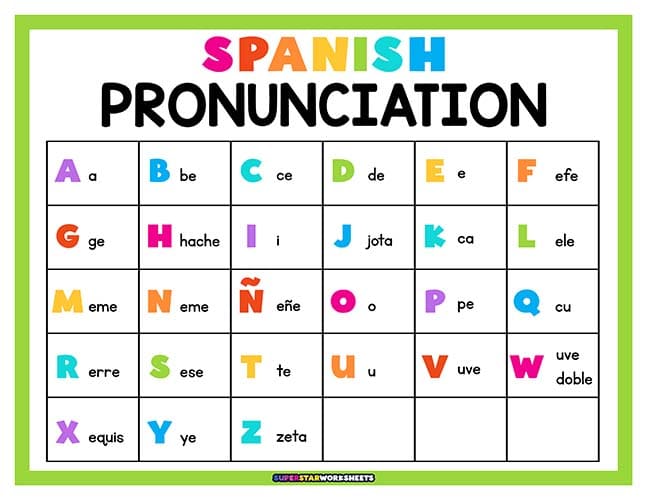 Spanish Alphabet Pronunciation Chart
But here’s where it gets juicy: in Argentina and Uruguay, they say it with a “sh” sound, like “sh” in “shy.” So Playboy (yes, it’s a brand, but also a name) becomes “Pleh-shee-boi.” It’s like a secret handshake for different countries. Which one sounds more fun to you?
The Famous ‘J’ Sound
The letter J in Spanish is a guttural breath from the back of your throat. It’s like you’re clearing your throat to say “ah” but with attitude. Think of the name José—it’s not “Joh-say,” it’s “Hoh-seh.” The J is a strong “h” sound, like in “Hanukkah” but rougher.
Try it: Javier becomes “Hah-vee-ehr,” not “Jav-ee-er.” It feels weird at first, like you’re trying to sound like a dragon. But practice it three times in the mirror, and you’ll feel like a cool linguist. Seriously, it’s addictive.
Double R? That’s a Rollercoaster
When you see a double R (rr), or an R at the start of a word, you have to roll it. It’s like a purring cat stuck in your mouth. Names like Roberto or Rosa start with a tap, but Carro (car) or Ferrocarril (railroad) demand a full trill.
Don’t panic if you can’t roll your Rs. English speakers often skip it, and Spanish speakers understand you perfectly. It’s like trying to snap your fingers—some people just can’t, but the point is the name. You’re still winning if you get the vowels right.
 How To Say Names In Spanish? Pronunciation Guide | WordSCR
Accents Are Little Road Signs
Spanish uses accents on vowels—like in José or María—to tell you where the stress goes. No accent? Stress the second-to-last syllable. Accent? Scream that syllable a little louder. For example, Ángel is “AHN-hel” (stress on A), while Ángela is “AHN-heh-lah” (stress on A again, because accent).
It’s like God decided to add cheat codes for foreigners. If only English had accents, we wouldn’t argue about whether “record” is a verb or a noun. Spanish is just fair. Why don’t we do this more often?
Why Bother? It’s About Respect and Fun
So why spend even five minutes learning this? Because names carry identity. When you say Ximena correctly—“Hee-meh-nah” (the X is an “H” sound in old Spanish)—you’re not just pronouncing letters. You’re saying, “I see you, I hear you, you matter to me.” That’s powerful.
Plus, it’s a party trick. Imagine meeting someone named Guillermo. You coolly say “Gee-yeh-r-moh” instead of “Gill-air-mo.” Their face lights up like you just gave them a gift. And you did—the gift of not being misnamed for once.
In the end, Spanish pronunciation is a game of patterns, not rules. Once you unlock it, you’re not just speaking; you’re connecting. Go ahead, try one right now. Pick a name like Francisco—FrahN-sees-koh (not Fren-sis-ko). Feels good, right? You’re already improving.