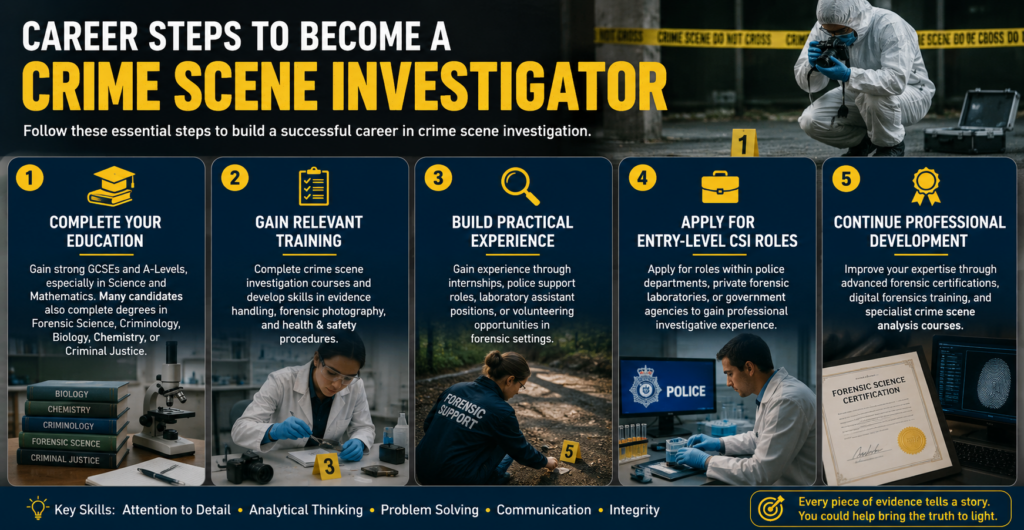
Ever since you first saw Gil Grissom examine a maggot under a microscope, or watched Temperance Brennan dust a femur for prints, the idea of being a Crime Scene Investigator has probably rattled around in your brain. It’s not just about the cool gear—it’s about being a detective for the silent stories that scenes tell. The good news? You don’t need a badge from a TV show to start walking that path; you just need curiosity and a plan that’s realer than prime-time.
Step 1: Ditch the Drama, Embrace the Science
Science is your foundation, not just a plot device. You’ll need a background in forensic science, chemistry, or biology. Think of it as the difference between knowing what gunpowder looks like and understanding why it burns in a specific pattern. Fun fact: The word “forensic” comes from the Latin forensis, meaning “of the forum.” Roman citizens debated evidence in public squares. You’re just carrying that tradition into a sterile lab and a mud-caked field.
Community college courses are a fantastic, low-pressure starting point. Take a class on human anatomy, and you’ll realize why a skeleton’s knee joint looks exactly like the hinge on your front door. That kind of mundane observation is pure gold.
Step 2: Get Certified, Not Just Photogenic
You can’t just show up to a crime scene with a magnifying glass and a dream. Look into certifications like Certified Crime Scene Investigator (CCSI) offered by the International Association for Identification. It’s the professional equivalent of getting a black belt in evidence gathering. Practical tip: Many investigators start as police officers, but some civilian agencies hire directly. Check your local law enforcement’s requirements—it’s like applying for a creative job, except your portfolio contains evidence logs instead of Instagram reels.
Don’t forget specialized courses: bloodstain pattern analysis, fingerprint recovery, and digital forensics. The latter is huge right now, because your phone leaves more clues than a clumsy burglar on a gravel driveway.
Step 3: Train Your Eyes Like a Wildlife Photographer
Crime scenes are chaotic, but your job is to see the pattern in the noise. Start practicing now: walk into a messy living room and count the objects out of place. Notice the smell of stale coffee versus burnt wiring—they mean different things. Cultural reference: Remember the detective in True Detective (Season 1) who notices the twisted grass? That’s not drama; it’s observation. You need to notice that a single strand of hair pointing east means the body was moved.
A great trick: always work from the outside in. Enter a scene like you’re entering a sacred space—because, ethically, you are. The evidence is vulnerable, and your eyes are its first protector.
Step 4: Master the Art of The Question
You’re not just collecting objects; you’re interviewing the scene. Every mark, every scuff, every missing item asks a question. “Why is this chair positioned exactly three feet from the wall?” “Why is there cat hair on a man who claimed to be allergic?” Documentation is everything. Write down every detail, even the ones that seem boring. A single faded receipt on a counter might be the key to a timeline, or it might be yesterday’s lunch trash. You won’t know until the trial. Fun fact: The first recorded use of fingerprint evidence was in 1892 in Argentina. A woman named Francisca Rojas was convicted of murdering her two sons because her bloody thumbprint matched the door frame. That one print changed everything.
Step 5: Learn to Pack Your Bag Like a Minimalist Traveler
A CSI kit is not a toy box. You need light sources, tweezers, sterile swabs, evidence bags, and a good camera. Forget the loud gadgets; the real star is the alternate light source. Turn off the lights, and suddenly a hidden fluid stain glows like a secret message. Practical tip: Always carry multiple pairs of gloves—nitrile, not latex. Latex allergies are common, and you don’t want your hands swelling up while you’re trying to bag a shell casing.
Label everything immediately. The crime scene doesn’t care if you forgot to write the date on the bag. The judge certainly won’t.
Step 6: Build an Iron Stomach (and a Soft Heart)
This is the part TV glosses over: you will see things that haunt you. An autopsy report is clinical; standing in a room where someone took their last breath is visceral. You need emotional resilience, not emotional numbness. Self-care is not optional. Meditation, intense exercise, or a good comedy podcast can save your sanity. Many departments require mandatory counseling after certain scenes. Take it seriously. Cultural reference: Think of the character Rust Cohle in True Detective again—he almost lost himself in the darkness. Don’t be Rust. Be the version who solves the case and goes home to water their plants.
Step 7: Never Stop Learning, Even When You’re Tired
Forensic science evolves faster than your phone’s operating system. New techniques, like 3D scanning or microbial fingerprinting, pop up every year. Read journals, attend conferences, get coffee with older investigators. Fun fact: Insects can actually give a time of death more accurately than a watch. A blowfly’s life cycle is so predictable that entomologists have been called to court to testify about maggot growth rates. Gross, but brilliant.
Stay curious. The day you think you know everything is the day you miss the one detail that cracks the case wide open.
A Short Reflection Tied to Daily Life
You might never swab a knife for DNA or photograph a splatter pattern. But the real lesson of the crime scene investigator is this: pay attention. Every interaction, every conversation, every quiet moment holds clues about the people around you.
When you walk into a room, notice the tension in someone’s shoulders. Hear what isn’t said. See the invitation that was never sent, the apology that was never made. Life is just a series of scenes, and you are the investigator of your own story.
So start today: observe your morning coffee with the same focus you’d give a shell casing. The world is full of small, telltale truths. All you have to do is look.
