
Let’s be honest: cooking a chicken breast can feel like a high-stakes game of chance. You’re either risking dry, sad rubber or undercooked chicken that sends you straight to food-safety hell. But there’s a magic number that changes everything: 165°F (or 74°C). That’s the internal temperature where the USDA says your chicken is safe and succulent.
Why that number? It’s the point where the heat kills off the nasty bacteria, like Salmonella and Campylobacter, that love to crash the party. Think of it as the chicken’s safety net—no drama, just science with a side of relief. Once you hit 165°F, you can breathe easy and start carving.
But here’s the fun twist: carryover cooking is your secret weapon. When you pull your chicken off the heat at around 160°F, the residual heat will nudge it up to that perfect 165°F while it rests. This trick keeps the juices locked in, so your breast stays tender instead of turning into shoe leather.
Now, let’s get cultural for a second. Think about that perfect chicken tikka at your favorite Indian spot—the kind that’s moist and spiced to heaven. Or a classic coq au vin, where the breast is braised so gently it almost falls apart. These dishes teach us that temperature isn’t just about safety; it’s about respecting the protein.
Your practical temperature toolkit
First, invest in a decent instant-read thermometer. Forget the fancy gadgets—a simple digital one for under $20 is your best friend. Stick it into the thickest part of the breast, avoiding bone, and wait for that steady reading. Trust me, your taste buds will thank you.
Second, don’t rely on color. A golden-brown exterior can be dangerously undercooked inside. And that clear juice myth? It’s a gamble. Only a thermometer gives you the cold, hard truth—no guesswork, no stress. Think of it as a tiny truth-teller for your kitchen.
Third, rest your chicken for five minutes after cooking. This allows the juices to redistribute, making every bite wetter and more flavorful. Cover it loosely with foil, and resist the urge to slice right away. Patience is a small price for perfection.
A fun little fact for dinner parties
Did you know that the 165°F standard comes from a logarithmic death curve? Sounds fancy, but it just means that bacteria die off faster at higher temperatures. If you held your chicken at 136°F for an hour, it would be equally safe—but nobody has that kind of time. So 165°F remains the quick, reliable hero.
Another tidbit: In Japan, they often serve toriwasa, a slightly seared chicken breast, at a lower temperature. It’s a cultural dance with risk, but it shows how temperature norms vary worldwide. For most of us, though, sticking to 165°F keeps dinner worry-free and delicious.
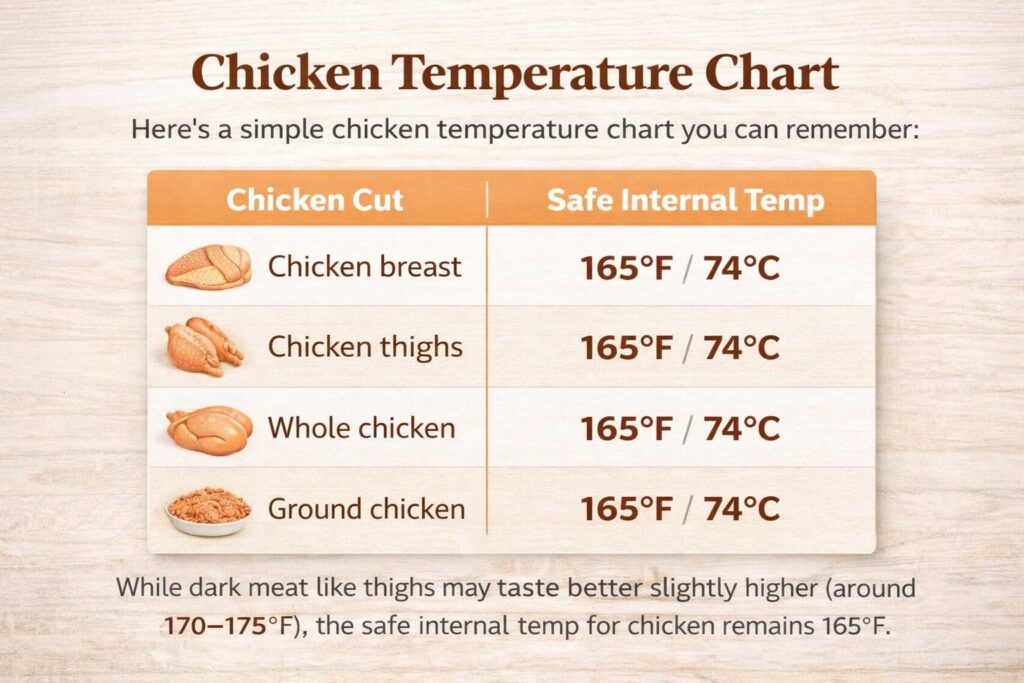 Chicken Internal Temp: The Secret to Safe, Perfect Chicken - Foodiosity
And here’s the real kicker: overcooking is a tragedy. Once you go past 170°F, the proteins start squeezing out moisture like a sponge in a fist. That’s why so many home cooks end up with dry chicken—they’re chasing “done” instead of precisely done. A thermometer stops that sorrow in its tracks.
How to nail it every time
Start by pounding your chicken to even thickness—about half an inch. This ensures it cooks uniformly, so one end isn’t raw while the other is desiccated. Then, season generously with salt, pepper, and a dash of paprika for color. Heat a mix of butter and oil in a pan until it shimmers.
Sear the breast for four minutes per side over medium-high heat, then finish it in a 350°F oven for about ten minutes. Check the temp at the seven-minute mark—you’re aiming for 160°F. Let it rest, and you’ll be rewarded with a breast that’s golden, juicy, and nothing short of remarkable.
If you’re grilling, same logic applies: indirect heat is your pal. Sear over flames, then move to the cooler side until you hit that sweet spot. Use a thermometer to guide you, not a timer. Timers lie; thermometers tell the truth.
One more pro tip: brine your chicken for thirty minutes in salt water. It seasons the meat deep inside and locks in moisture, making that 165°F target even more forgiving. Add a bay leaf or some garlic for a subtle, aromatic boost.
So the next time you’re staring at a raw chicken breast, remember this: it’s not about guessing. It’s about knowing. That simple beep from your thermometer is the sound of confidence—and a dinner you’ll actually enjoy.
Reflection: In a world full of uncertainty, the temperature of a fully cooked chicken breast is a small, quiet assurance. It reminds us that control exists in the details—how we measure, rest, and trust the process. And maybe that’s a lesson for life, too: sometimes the most satisfying outcomes come from paying attention to the numbers, then letting the rest happen on its own.