
Okay, let’s talk turkey. But not just any turkey—we’re dialing in on the temperature of roasted turkey breast. Sounds a bit technical, right? But trust me, the science behind a juicy slice is way more exciting than you’d think.
Have you ever carved into a holiday bird and found it dry as dust? That’s a temperature tragedy. The difference between a perfect bite and a sad, crumbly mess is literally just a few degrees on your meat thermometer.
Think of your turkey breast as a two-act play. The first act is the raw protein, all coiled up tight. The second act is that glorious, tender, oven-hot meat we all crave.
Must Read
The Magic Zone: Where Juiciness Lives
The real sweet spot for roasted turkey breast lies between 150°F (65°C) and 155°F (68°C). Why there? Because a little known process called carryover cooking kicks in.
When you pull the bird out of the oven, its internal temperature keeps climbing by about 5 to 10 degrees. So, if you take it out at 150°F, it will safely coast up to 155°F or even 160°F while it rests. It’s like the turkey is finishing its own roast while you pour the gravy!
This is huge. The USDA recommends 165°F for safety, but hitting that mark in the oven often means you’ve overshot by the time it rests. The result? A dry, sad breast.
Why Your Oven Thermometer Lies (Sort of)
You might be thinking, “But the pop-up timer says 165°F!” Yes, but that little plastic tab is often calibrated to a higher temp for super-safety. It’s not your friend; it’s the enemy of moisture.
Here’s the nerdy, cool part: At 150°F, the proteins in the meat (like myosin and actin) are just starting to unwind. They squeeze out all their trapped water if you go any hotter. That’s the sweet squeak of dry turkey.
When you nail the 150°F zone, the meat hasn’t fully surrendered its juices. It’s like a sponge that’s still holding onto every last drop of flavor. That’s why it tastes so much better.
The “Resting” Ritual: Patience Pays Off
So you’ve pulled the breast at 150°F. Now what? You do not carve it. You let it rest for at least 15 to 20 minutes. This is non-negotiable.
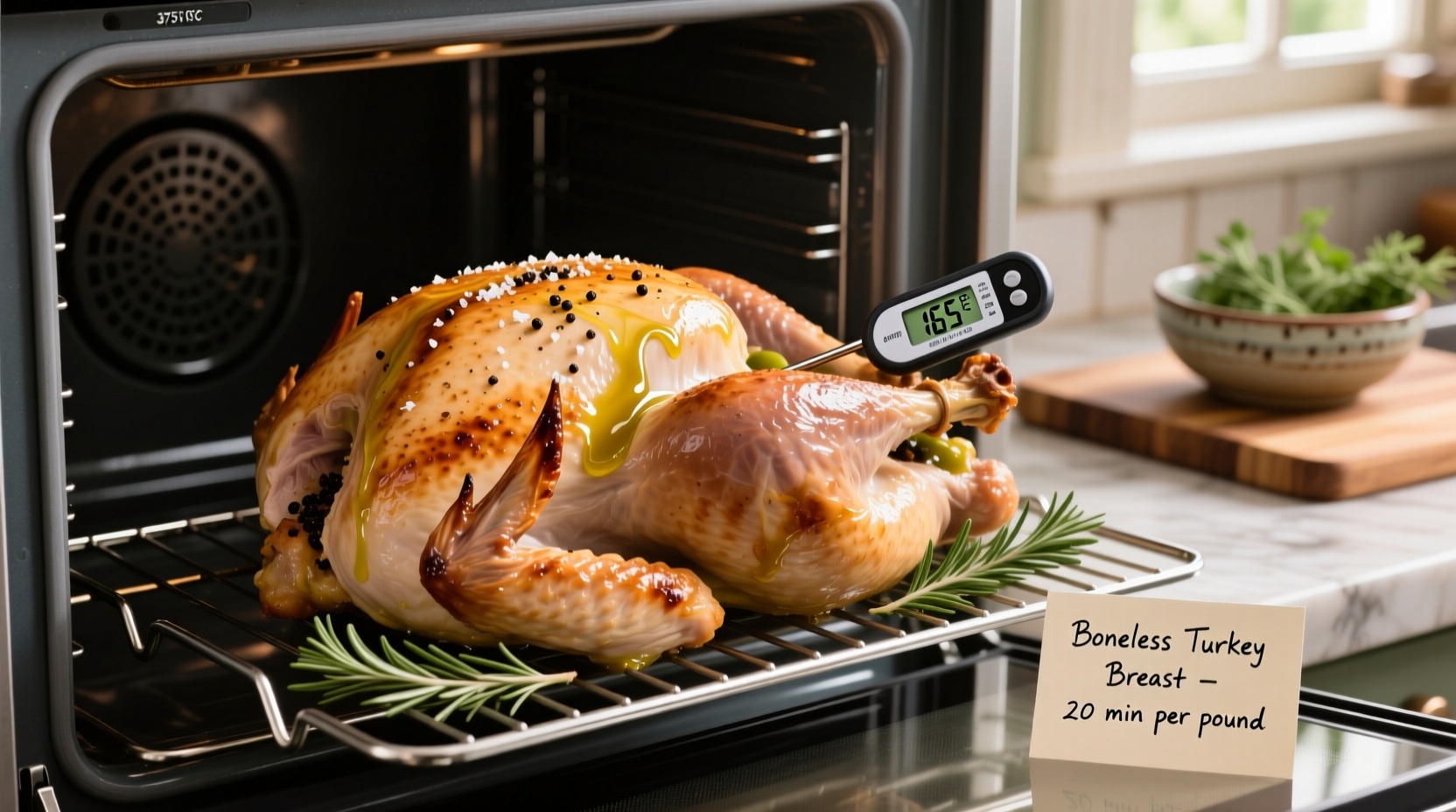 Turkey Breast Cooking Time: Minutes Per Pound Guide
During that rest, the juices—which have been running wild from the heat—calm down. They reabsorb back into the meat fibers. Carve too early, and you’ll have a pool of sad turkey broth on your cutting board.
Think of it like letting a pizza cool before you bite into it. The cheese burns your mouth if you rush, but if you wait, it turns into a perfect, gooey slice. Same idea, but with juicy meat.
Fun Comparisons to Keep You Hooked
Roasting a turkey breast is basically the culinary equivalent of driving a car. The temperature is your speedometer. If you go 165°F in the oven, you’re flooring it past the exit and into a ditch of dryness.
It’s also like making a perfect steak. You wouldn’t cook a filet mignon to 165°F, right? You’d aim for medium-rare (around 135°F). Turkey is a little different, but the principle is the same: lower temps = more moisture.
And have you ever noticed how a hard-boiled egg turns rubbery if you boil it for too long? That’s the same protein-squeezing process. Turkey breast is just a giant, delicious egg white.
The Takeaway: Don’t Fear the Pink (Sort of)
Now, a little caution: Turkey breast at 150°F can sometimes look slightly pink near the bone. That’s not raw—it’s just the myoglobin reacting to heat differently. It’s safe as long as the thermometer says 165°F total after carryover.
But the real adventure is trusting the process. Get a good instant-read thermometer—the kind that beeps at you. That click when it reads 150°F is the sound of victory.
So next time you’re roasting a breast, remember: 150°F is the golden ticket. Your guests will wonder why your turkey is so much juicier than anyone else’s. You can just smile and say, “It’s all about the temperature, man.” And you’ll be telling the exact truth.