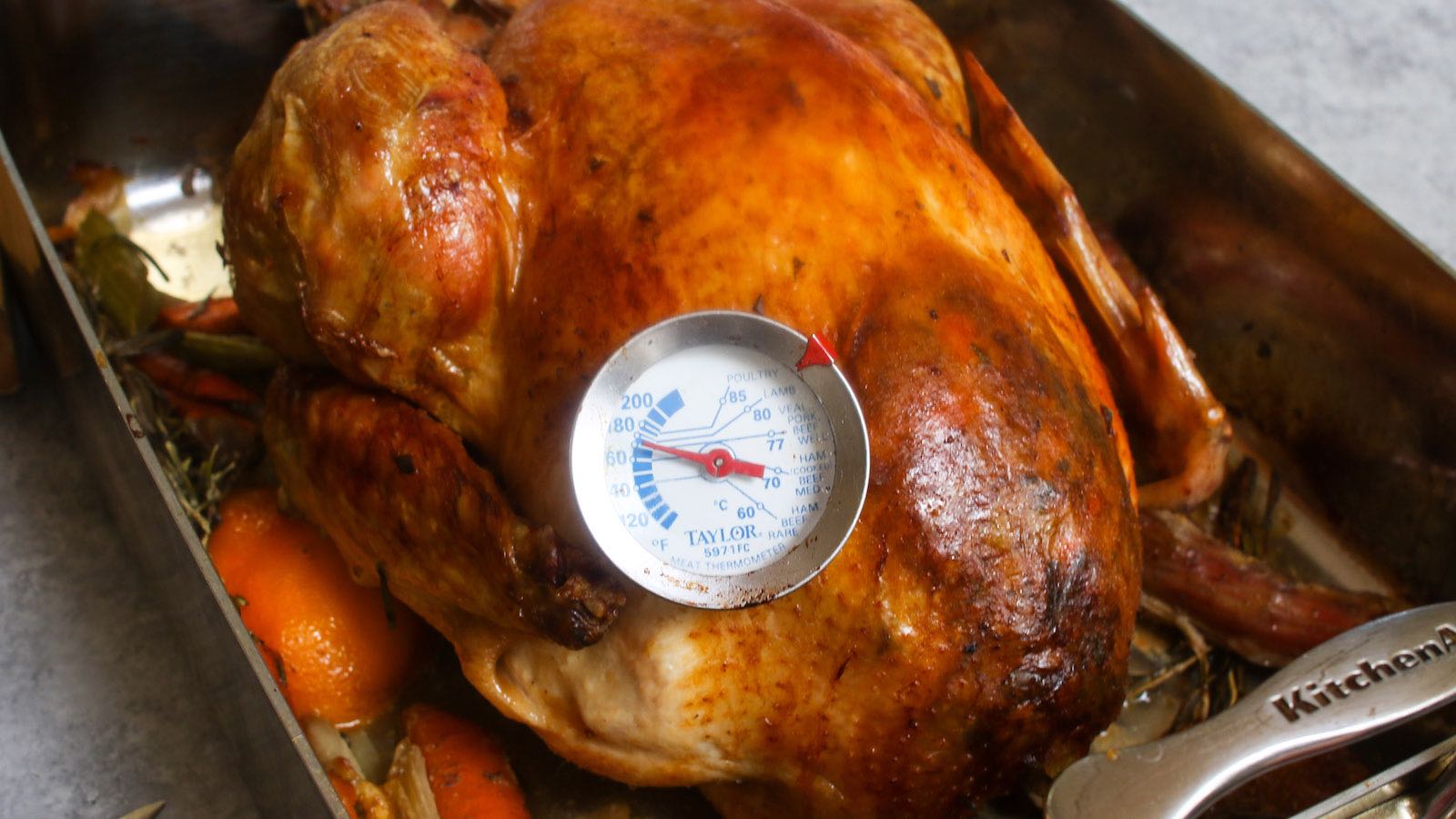
Alright, let’s talk turkey. Not the country, but the big, golden bird that terrorizes kitchens every November (and, let’s be honest, for random Tuesday dinners too). You know the drill: you pull it out of the oven, it looks like a magazine cover, and then someone asks, “Is it done?” Cue the panic.
Here’s the thing: size and color are liars. You cannot tell if a turkey is cooked by how brown the skin is or how many times the pop-up timer has jumped. That plastic thing is about as reliable as a broken clock—it’s right twice a day, but I wouldn’t bet my Thanksgiving on it. Trust the numbers, not your eyes.
The Magic Number: 165°F
The USDA says the entire turkey must hit 165°F in the thickest part of the breast and the innermost part of the thigh and wing. Why 165? It’s the temperature where salmonella and friends throw up their hands and surrender. Think of it as the turkey’s “safe word.”
Must Read
But here’s a little secret: carryover cooking is your best friend. Once you pull that bird out, the internal temperature keeps rising by about 5 to 10 degrees while it rests. So if you yank it at exactly 165°F in the breast, it might climb to 170°F. That’s fine, but if you’re aiming for juicy meat, you’ve got a window to play with.
Where to Measure (Please Don’t Guess)
You need to hit three zones: the breast (thickest part, not touching bone), the thigh (right where it meets the body, not touching the cavity), and the wing (the thickest area by the body). The thigh is the slowest to cook, so if it’s done, the rest is usually good. But check everything—paranoia is a flavor.
Oh, and please invest in an instant-read thermometer. A $10 digital one from the supermarket is better than a $100 guess. And no, you cannot use the one you keep in your ear for fevers. That’s weird. And unsanitary.
The “Juicy” Myth vs. Reality
Everyone wants a moist turkey, but overcooking is the real enemy. If you let the breast get to 180°F, you’ve just created poultry sawdust. The dark meat can handle a bit more (175°F to 180°F is glorious), but the white meat is a diva. It prefers 155°F to 160°F, then it coasts to 165°F while resting.
Here’s a pro tip: spatchcock that bird. That’s fancy chef talk for cutting out the backbone and flattening it like a roadkill pancake. It cooks faster and more evenly, and you get maximum crispy skin. Your guests will weep with joy, and you’ll feel like a genius.
What About Stuffing?
If you stuff your turkey (which, honestly, is a hostage situation), the stuffing also must reach 165°F. But here’s the rub: by the time the stuffing is safe, the breast is often a desert. My advice? Cook the stuffing separately. Put it in a casserole dish, drizzle some broth on it, and bake it while the turkey rests. Your meat will thank you. Your stomach will thank you. Your dentist will… well, he won’t care, but everyone else will.
 Here's What Temperature to Cook a Turkey So It Stays Moist
And for the love of gravy, don’t rely on the pop-up timer. Those things are calibrated to pop at weird temps, sometimes after the bird has been overcooked for 20 minutes. If you want to use it, stick a thermometer into it and see if it agrees. (Spoiler: it usually won’t.)
The Resting Game
Once the turkey hits your target temp (breast at 155-160°F, thigh at 170-175°F), pull it out and let it rest for at least 20-30 minutes. Tent it loosely with foil—don’t suffocate it, we’re not making a shroud. During this time, the juices redistribute, the temperature climbs to 165°F with zero effort from you, and you can finish the sides without rushing.
I call this the “turkey nap.” It’s the most productive part of your day. You sip wine. The bird snoozes. Everyone wins.
A Final, Silly Checklist
Before you serve, ask yourself: Is my thermometer clean? Did I wash it after poking the raw bird? (Yes, you did. Because you’re not a monster.) Did I check both thighs? Did I resist the urge to carve immediately? If you answered “yes” to all, you are a culinary hero.
And if the turkey does come out dry? Just drown it in gravy. No one will know. That’s what gravy was invented for—hiding our sins and making everything taste like heaven.
So go forth, brave cook. You’ve got this. With a thermometer in one hand and a spatula in the other, you’re not just cooking a turkey—you’re outsmarting bacteria, impressing your in-laws, and becoming the legend your kitchen deserves. And if all else fails, remember: pizza exists. But you won’t need it. Because your turkey, my friend, is perfect. Now pass the cranberry sauce and let’s eat!