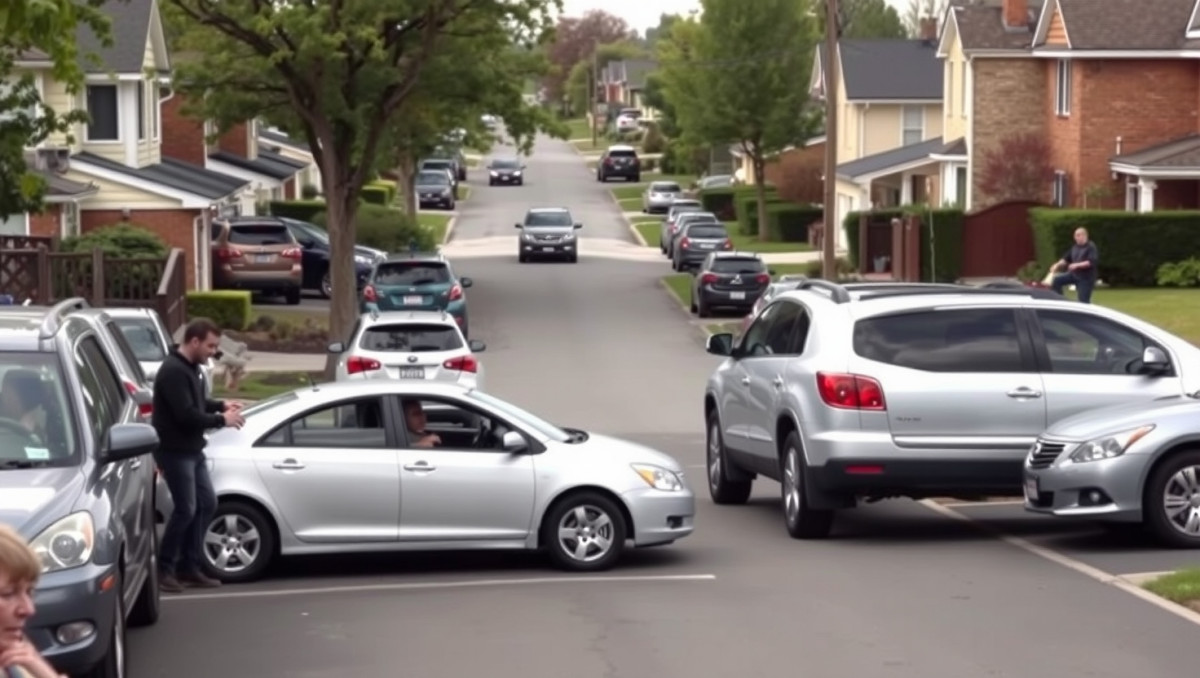
There’s a certain type of chaos that only a tight British street can produce. In Bristol, one mother has become a local legend simply by refusing to stop parking. Her crime? Using a spot that her neighbor claims is his private driveway.
The Battle of the Bitumen
It all started with a strip of concrete so narrow it could barely fit a Fiat 500. The neighbor insists it’s his land, bought and paid for in the deeds. But the mother, a busy parent with school runs to manage, sees it differently.
She parks there every day, smiling at the cameras. The neighbor has threatened solicitors, councils, and even called the police, but the law is surprisingly vague here.
Must Read
In England, driveway disputes are a national sport, right up there with moaning about the weather. According to the Land Registry, over 20,000 boundary disputes are reported annually. Most never get resolved amicably.
The Cultural Context
This isn’t just about parking. It’s about principle. Brits have a deep, almost spiritual connection to their front curb—a space often declared “sacred” in neighborhood WhatsApp groups.
Remember the classic episode of Only Fools and Horses where Del Boy fought for a parking space? This is that, but with better lighting and more passive-aggressive notes. The Bristol mother has become a folk hero for the fed-up driver.
She reportedly told local media: “I have three kids and a cat. I’m not walking twenty meters because someone thinks they own a piece of tarmac.” You can’t argue with that logic, really.
What the Law Actually Says
Here’s where it gets juicy. In the UK, driving over a driveway is one thing, but parking on it is another. If the neighbor can prove absolute ownership, the mother could face a civil lawsuit for trespass.
But proving ownership of a tiny strip that’s been used by the public for decades? That’s a solicitor’s dream—and a nightmare for your wallet. Adverse possession (the “squatter’s rights” of land) can kick in after 12 years of continuous use, even if you don’t own it.
Fun fact: In 2017, a man in London won a driveway battle because his neighbor’s car had parked there for 15 years. The court ruled the space had become public in practice. The mother in Bristol might have history on her side.
 New task force to tackle scourge of pavement parking
Practical Tips for the Rest of Us
Are you living dangerously close to a boundary line? Here’s how to avoid becoming a meme on local Facebook groups:
1. Check your deeds. Look for the “T” marks on the map. A “T” with the stem inside your land means you own the boundary. No T? You’re probably sharing the headache.
2. Communicate with your neighbor. Sounds obvious, but a friendly chat over a cuppa can solve 80% of disputes. The other 20% end up on Witness documentary specials.
3. Don’t escalate to war. Putting up bollards or parking a Lorry in retaliation (yes, it’s happened) usually backfires. Instead, try a polite note: “Hi, I think we have a space issue—want to talk?”
The Ripple Effect in Bristol
The local council has now stepped in, but they’re walking on eggshells. They’ve painted a yellow line on part of the disputed area, which has only made things worse. Now everyone hates the council, too.
Neighbors are taking sides. One resident told the Bristol Post: “She’s a mother, she needs access. But he’s a retired man, he needs peace. It’s a mess.” This dispute has become a microcosm of modern British life: individual rights versus communal sanity.
Meanwhile, the mother’s kids find the whole thing hilarious. They’ve started calling the neighbor’s car “The Grump-mobile.” Kids have a way of cutting through adult nonsense.
 Parking: Angry mother sparks debate after neighbours park on her
A Little History Lesson
Believe it or not, driveway disputes are as old as cars. The first recorded parking argument in the UK happened in 1903, when two horse-drawn carriage owners argued over a spot outside a London pub.
Fun fact: The word “driveway” only entered common English in the 1930s, when suburban homes boomed. Before that, it was just “the path to the stable.” We’ve been fighting over it for nearly a century.
In Bristol, where there are more cars than driveways in many districts, the tension is palpable. It’s like a game of Monopoly, but everyone forgets the rules and no one gets a Community Chest card.
Final Reflection: The Art of Letting Go
So, who’s right in this Bristol saga? The law is still undecided, but the court of public opinion leans toward the mother. She’s just trying to get her kids to school on time, after all.
But here’s the thing: disputes over space often reflect deeper anxieties. The neighbor might feel his territory is invaded; the mother feels her time is stolen. Both are valid, but neither is worth a year of stress.
In daily life, we all have these little battles—the parking spot, the line at the coffee shop, the seat on the train. The question isn’t who wins, but whether the victory is worth the sour taste in your mouth.
Perhaps the best solution is a quiet cup of tea and a map. Or, as the Bristol mother might say, “Just park where you can and smile.” Sometimes, the most British rebellion is a shrug and a polite wave through the rearview mirror.