
Picture this: you’re stranded on a desert island, surrounded by salty ocean, and your throat feels like sandpaper. Your brain whispers, “Just freeze the water and the salt will disappear, right?” It’s a classic survival myth, one that has starred in everything from Gilligan’s Island to casual campfire debates. Spoiler alert: freezing salt water doesn’t simply remove the salt—but the truth is far more fascinating than the fiction.
The Cold, Hard Science Behind Ice and Salt
Here’s the core truth: when salt water freezes, the ice crystals that form are almost pure water. Salt molecules are essentially “kicked out” of the ice structure as it solidifies, a process called brine rejection. That’s why icebergs floating in the Arctic Ocean are mostly fresh—you could literally melt one and drink it, assuming you haven’t packed a cocktail umbrella and a sun hat.
But wait—this doesn’t mean you can just toss a bucket of seawater in your freezer and expect fresh cubes. Speed matters. If the water freezes too quickly, impurities, including salt, get trapped in tiny pockets within the ice. Think of it like a snow globe shaken too hard—the salt doesn’t have time to escape the crystal lattice.
Must Read
For a real-world example, look to sea ice in polar regions. Over months, the ice naturally “drips” out the brine, becoming progressively fresher. Eskimo cultures have known this for millennia, using old sea ice for drinking water. Nature is clever, but your home freezer isn’t a slow-motion Arctic winter.
Can You DIY a Desalination Ice Cube?
Technically, yes—but it’s a labor of love, not a quick fix. The fractional freezing method involves partially freezing salt water, then scooping out the fresh ice that forms on top. You’d need to repeat the process several times to get truly drinkable water, and your energy bill would rival a supermodel’s spa habit.
A fun little fact: ancient mariners used this trick to supplement their fresh water supplies. They’d leave buckets of seawater out during frigid nights, then chip away the top layer of ice in the morning. It was slow, cold, and inefficient, but when your other option is a salt-laced grog, you get creative.
If you’re itching to test this at home, start with a shallow tray of salt water in your freezer. Check it every hour and skim off the first solid layer. Taste it—you’ll get a barely drinkable result, but it’s more of a parlor trick than a sustainable solution. Modern desalination plants use reverse osmosis, which is about as exciting as watching paint dry but far more effective.
Cultural & Pop Culture Shout-Outs
Remember that scene in Lost where they try to catch rainwater? Or in The Martian where Matt Damon uses science to not die? Freezing salt water is the same spirit—except it’s way less dramatic and involves fewer potatoes. The real hero is evaporation, which is how most survival manuals suggest you purify ocean water (think solar stills).
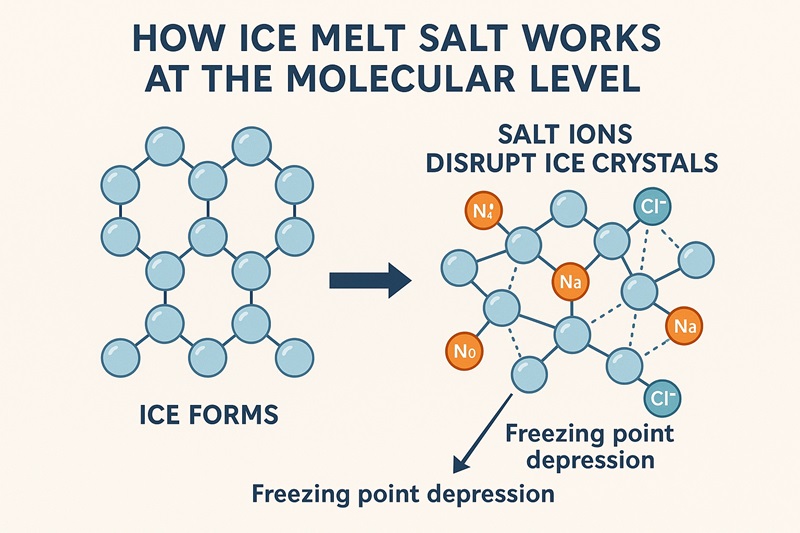 Ice Melt Salt: The Hidden Chemistry Keeping Winter Roads Safe - The
In coastal towns like Santorini or Maldives, locals will tell you that ice made from seawater tastes “wrong.” That’s because even the best freezer trick leaves a hint of bitterness. Cultural wisdom often beats backyard science—trust the fisherman over the TikTok hack.
Here’s a cocktail party gem: your margarita salt is thanks to old solar evaporation ponds, not ice. Salt from the sea costs pennies; fresh water is the real luxury. Next time you clink glasses, toast the fact that freezing is nature’s filter, just not a very fast one.
Practical Tips for the Curious
If you’re really out of water and have only a freezer and a dream, start with a low-saline solution. Brackish water (like from a river mouth) works much better than full-strength seawater. Use a plastic bottle, fill it two-thirds, and freeze it on its side—the ice forms purer near the top.
Pro tip: don’t forget the salt’s depression point. Salt water freezes at a lower temperature than fresh (around -2°C vs 0°C). Your freezer might not be cold enough to freeze high-salt water solid—think of it as nature’s “you can’t cheat me” button. For reference, the Dead Sea never freezes because it’s too salty.
For the survivalist crowd: freezing is a last resort. Burning, filtering, or distilling water is faster and safer. But if you’re stuck in a Cast Away-esque scenario and have time, try building a “frost trap”—a metal bowl placed atop salt water in freezing air will collect pure frost overnight. It’s slow, but it’s yours.
 Freezing Salt Water Science Experiment (teacher made)
So, Does It Work or Not?
The answer is a delightful, infuriating “yes, but no.” Freezing salt water does remove a significant amount of salt, but not all of it, and not efficiently enough for modern life. It’s like trying to use a spoon to bail out a sinking boat—possible, but you’ll probably get tired before the boat floats.
What this myth teaches us is bigger than chemistry: we often assume nature is simpler than it is. Salt and ice are in a complex dance, and we’re just the audience. The next time you watch ice form in an ice cube tray, remember—your drink’s purity is a miracle of physics, not a party trick.
A Short Reflection for Your Daily Life
In a world of instant gratification—filters, gadgets, shortcuts—the freezing salt water experiment is a gentle reminder that some things take time. You can’t rush purity, whether it’s in water, relationships, or that sourdough starter you keep killing. Letting ice slowly reject the salt is like letting a friendship sit through a rough season; what remains is clearer, stronger, and worth the wait.
So, next time you’re at a dinner party and someone brings up this myth, you can smile, nod, and casually drop that brine rejection is why polar bears drink from icebergs. Then suggest they stick to boiling or buying a filter. And if they insist on the freezer method? Hand them a salt shaker and say, “Good luck—you’re going to need a lot of patience.”
After all, some truths are best served chilled.