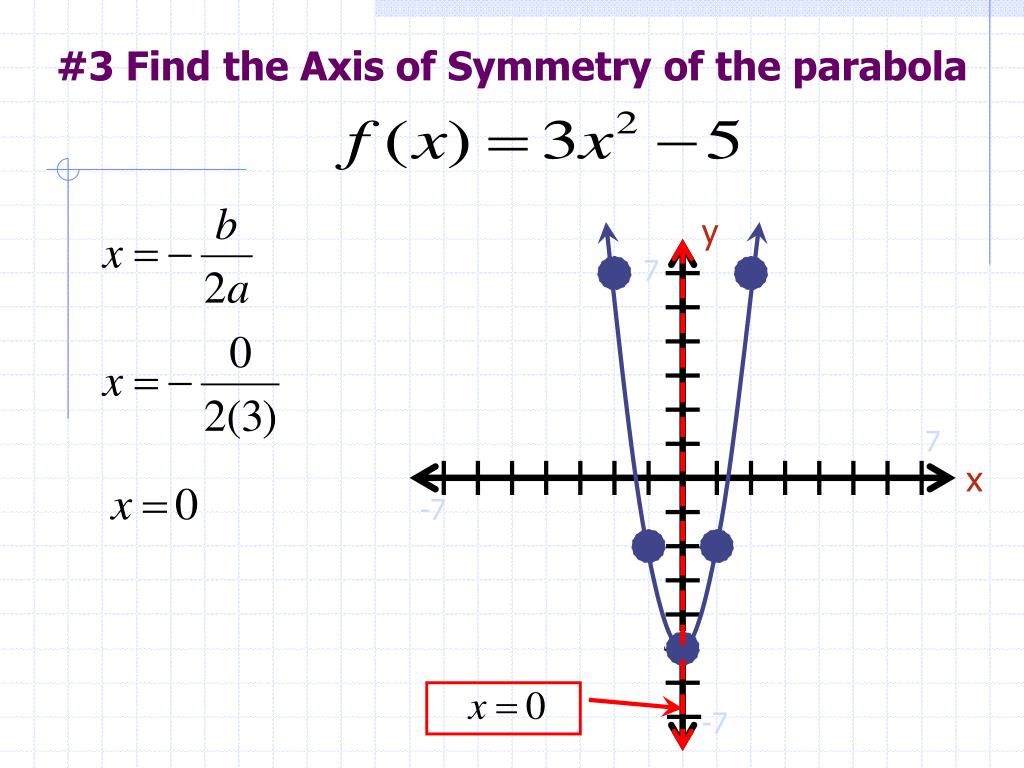
Alright, gather ‘round. You’ve been staring at a quadratic equation—that thing that looks like y = ax² + bx + c—and someone told you it has a “spine.” Actually, it’s called the axis of symmetry. It’s the invisible line that splits your parabola into two perfect, evil-twin mirror images.
Think of it like your friend’s face after they’ve had one too many espressos. One side is twitching, the other is calm—but the axis (usually their nose) keeps everything from spinning into chaos.
Now, you don’t need to be a math wizard who sacrifices calculators to the gods. You just need one weird little trick. Ready? Here’s the formula: x = -b / (2a). That’s it. That’s the whole party.
Why is this formula so shockingly simple?
Because mathematicians are lazy geniuses. They realized that every parabola is born symmetrical, like a butterfly that only flies in straight lines. The axis of symmetry is the line that runs through the vertex—the parabola’s highest or lowest point, where it looks like a grumpy mountain or a happy valley.
Here’s the surprise: That little formula—-b over 2a—is actually the average of the two x-intercepts (if they exist). Imagine you have two friends arguing about where to eat. The axis is the restaurant they’d both bribe you to choose. Fair and balanced, like a math-themed Switzerland.
Let’s walk through it like you’re explaining it to a cat.
Take the equation y = 2x² + 8x + 5. Your cat doesn’t care, but you do. Identify a and b. Here, a = 2 and b = 8. C is just sitting there eating snacks—useless for now.
Plug into the formula: x = -8 / (2 * 2). That’s -8 divided by 4, which equals -2. Boom. The axis of symmetry is the vertical line x = -2. Draw it on a graph and your parabola will high-five itself.
If you mess this up, the parabola will look like a melted witch hat. I’ve seen it happen. It’s not pretty.
 Axis Of Symmetry
But wait—what if the equation is already factored?
Oh, you think you’re slick, handing me y = (x - 3)(x + 1)? Fine. The zeros are x = 3 and x = -1. The axis is the midpoint between them. Add them: 3 + (-1) = 2. Divide by 2? 1. The axis is x = 1. Easy as grabbing the last cookie.
Fun fact: The ancient Babylonians had a version of this 4,000 years ago—but they used clay tablets and got sand in their formula. You’re welcome I upgraded you to breakable plastic calculators.
What if the equation is in vertex form: y = a(x - h)² + k?
Then you’re done before you started. The axis is x = h. Yes, just h. The “-” sign is already baked in like a math pastry. If your vertex is (2, 5), the axis is x = 2. No calculations, no crying.
This is the VIP lounge of axis-finding. Pass go, collect your parabola.
Here’s a surprising truth: The axis of symmetry never leaves the x-axis’s dance floor. It’s always a vertical line, because parabolas are drama queens that only flip up or down. If your parabola opens sideways (like a sideways smile), you’ve entered a different universe called “You’re in pre-calculus now, good luck.”
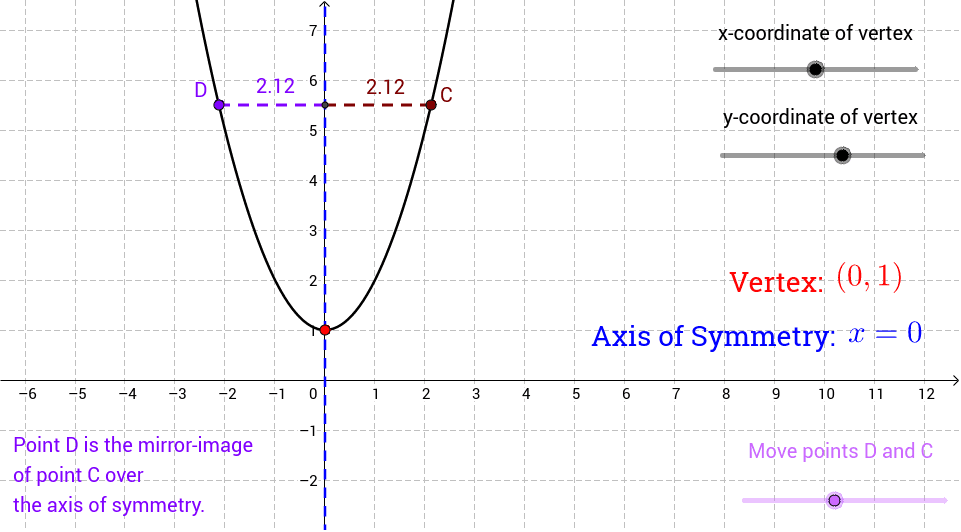 Axis Of Symmetry Page 1
Do not panic if the formula gives you a fraction.
For example, y = 3x² + 1x – 4. Then x = -1 / (2*3) = -1/6. That’s about -0.1667. Your axis is a thin line hovering near zero, like a cat deciding whether to jump on the counter. It’s okay. Fractions are just decimals wearing disguises.
One more thing: If a is zero—wait, that’s not a parabola. That’s a line. You’ve been tricked by a degenerate graph. Move on and try not to let it hurt your feelings.
Now, for the shocking part: The axis of symmetry is secretly the same concept as your face’s midline. Artists use it to draw portraits. Video game designers use it to make balanced characters. Even your coffee mug has one—otherwise, it’d tip over and ruin your morning. Geometry is everywhere, being symmetrical and smug about it.
So next time you see a parabola, don’t fear the math. Just whisper “-b over 2a” like a secret handshake. The axis will appear, graph will straighten up, and you’ll feel like a mathematical ninja who just stole the formula from the math gods.
And if all else fails? Draw a vertical line right through the middle of your graph. Scribble “close enough.” Only you will know the truth—and the axis of symmetry will forgive you. Probably.