
Remember that time, maybe around 2006, when you were so proud of your new flip phone? You’d be in a coffee shop, wait for your friend to say “Can you check the football scores?”, and you’d tap your Motorola RAZR with a theatrical flourish. Three seconds later, you had the answer.
That magic trick was called 3G. And now, after a solid twenty-year run, O2 is officially pulling the plug on it.
It feels a bit like finding out your favorite old diner is closing. You didn’t go there every week, but knowing it existed gave you a weird sense of comfort. “If my 4G or 5G craps out in the middle of nowhere,” you’d think, “3G has my back.”
Must Read
Well, not anymore. O2—part of the Virgin Media O2 family—has announced they’re shutting down their 3G network by the end of 2025. Actually, they started the process in 2023, but they’re really hitting the gas now.
Why? The short, slightly boring answer: Spectrum is a premium real estate. Those radio waves that 3G is hogging are like a prime city parking spot. Right now, it’s holding a rusty 1998 Honda Civic while a fleet of brand-new Teslas (aka 4G and 5G) is circling the block.
Let’s be real for a second. If you’re reading this on a smartphone bought after 2018, you probably haven’t consciously used 3G in years. Your phone is likely set to “LTE” or “5G Auto.” 3G was the backup friend you only called when your main friends were busy.
But here’s the kicker—it’s still a massive headache for thousands of people. Ever seen a senior citizen clutching a phone that looks like a tiny brick? Yeah, that’s a 3G device. So are many medical alert pendants, smart meters, and even some car emergency services (like old OnStar units).
O2 says they’re “giving customers plenty of notice.” Which in corporate speak means “we sent you one email in 2023 that you accidentally deleted.” If you’ve got a relative using an old Samsung Galaxy S3 or a Nokia that still has physical bezels, you might want to call them. (Seriously, call them. They’re probably already confused about why their “mobile internet” isn’t working).
What Was So Special About 3G Anyway?
Let’s take a nostalgia trip. 3G was the first time we felt truly “mobile internet” wasn’t a joke. Before 3G, you had GPRS (codenamed “waiting for a sloth to connect”). It was so slow, loading a single JPEG of your cat could take a full minute.
 Navigate the Shutdown of 2G and 3G Networks | TNS
Then 3G rolled in like a cool breeze. Suddenly, you could actually stream a song without it buffering for eternity. You could send a picture message (MMS!) that didn’t look like a pixelated mess. Remember Blackberry Messenger? Pure 3G glory.
Ironically, the thing that killed 3G was a video of a dog. Or an iPhone. When the iPhone 3G launched in 2008, it demanded more data than 3G could reasonably give. We wanted video, we wanted maps, we wanted constant social media scrolling. 3G said, “I’ll try my best,” and then promptly had a heart attack.
So we moved to 4G. And then 5G. And now, 3G is being turned off at the source.
What Happens If Your Phone Still Relies On It?
Simple: you get a paperweight. Not literally, but almost. Your grandad’s phone won’t make calls (yes, 3G handles voice calls in many older areas). Your car’s SOS button might just give you a sad beep.
O2 isn’t being completely heartless. They’ve promised to help vulnerable customers swap their phones. But here’s the irony—the most vulnerable people often don’t read tech news. They just wake up one morning, try to order a taxi, and… nothing.
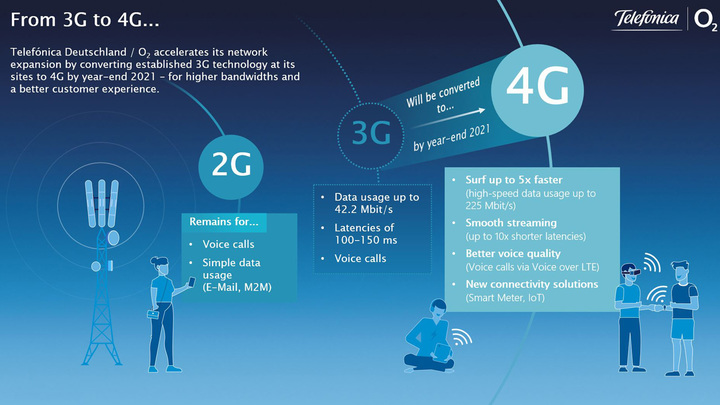
And don’t think this is just an O2 thing. It’s a full industry trend. Vodafone turned off their 3G in 2024. EE is doing it in 2025. Three already did it in 2023. O2 is just the last domino in the UK to fall.
 3G becomes 4G by the end of 2021: Telefónica Deutschland / o2
The Real Reason? It’s a Money Thing
Let’s not kid ourselves. O2 isn’t shutting this down to save the planet or to improve your Instagram scrolling. It’s cost vs. profit. Maintaining a 20-year-old network costs a fortune in electricity and engineers. Meanwhile, only about 2% of data traffic on O2’s network still goes through 3G.
Imagine running a restaurant where 98% of your customers order steak (4G), and you still keep the stove on for the one guy who orders a bowl of lukewarm oatmeal (3G). At some point, you tell the oatmeal guy, “Buddy, buy a steak or go to the coffee shop next door.”
That’s exactly what’s happening. O2 wants to take that “oatmeal” radio frequency and re-farm it for 5G. They’ll get faster speeds for everyone who upgrades, and they’ll save a chunk of cash. Win-win for them. Less of a win for the guy with the 20-year-old Nokia.
So, What Should You Do Right Now?
First, don’t panic. If your phone can use 4G or 5G, you won’t notice a thing. In fact, you might get slightly better battery life because your phone won’t constantly be searching for a dying 3G signal.
Second, be that person who asks your parents or grandparents: “Hey, does your phone say ‘3G’ in the corner?” If it does, offer to take them to an O2 store. Seriously. It’s a great excuse to buy them a new phone that actually works.
And finally, take a moment to say a quiet goodbye. 3G gave us mobile internet when we were still using those fat white earbuds with the plastic wire wrapping. It was slow, it was clunky, but dammit, it was our first step into being always online.
RIP, 3G. You weren’t the best, but you were the first to make it okay to look at your phone in public without feeling like a weirdo.