
Alright, grab your cuppa and settle in, because we’re diving into one of history’s most deliciously unsolved mysteries: the Princes in the Tower. Think of it as the original British whodunnit, minus the DNA tests and plus a lot of velvet doublets. It’s a story so juicy that Tudor historians basically turned it into the 16th-century equivalent of a Netflix true-crime docuseries.
So, picture this: it’s 1483, and England has just had a royal game of musical chairs. King Edward IV dies suddenly—probably from too much feasting and stress—leaving his 12-year-old son, Edward V, as king. But before the kid can even order a proper crown-fitting, his creepy uncle Richard III swoops in and shoves the boy into the Tower of London. Not for a fun sleepover, mind you.
The Tower was basically the royal Airbnb for VIPs before executions, but Richard insisted it was for the prince’s “protection.” Right. Uncle Richard then grabs Edward’s younger brother, nine-year-old Richard of Shrewsbury, and locks him up too, for company. What a sweet guy.
Must Read
Fast forward a few months, and poof—the princes vanish from history faster than a biscuit at a tea party. No bodies, no confession, just a lot of Tudor gossip and creepy legends. The official line is that the boys were “dead,” but no one ever found the bones—until 1674, anyway. But we’ll get to that spooky bit in a sec.
Who offed the little royals?
The prime suspect, of course, is Uncle Richard III. He had motive (he wanted the throne), opportunity (he had the keys to the Tower), and the personality of a man who definitely didn’t return shopping carts. Shakespeare later painted Richard as a hunchbacked, baby-eating monster, which is a bit of an exaggeration—but still, the dude did steal the crown from two kids.
But here’s where it gets hilariously murky. Richard was overthrown in 1485 by Henry Tudor (Henry VII), who then married the princes’ sister, Elizabeth of York. Henry also had a motive to make Richard look like a child-murdering villain—it justifies his own reign. So was Richard really guilty, or was Henry just the best PR spin doctor of the 15th century?
Surprising fact: in 2013, archaeologists found Richard III’s skeleton under a parking lot in Leicester. But guess what? No signs of child murder on his bones. Meanwhile, Henry VII never launched a formal investigation into the princes’ deaths. Suspicious? You bet.
 Who Killed The Pig Giessen Wine
The bones in the box
Jump to 1674, when workers renovating the Tower found a wooden chest under a staircase containing the skeletons of two children. They were roughly the ages of the princes. King Charles II (who had zero chill) declared them the princes and had them buried in Westminster Abbey—with zero forensic analysis. Classic 17th-century vibes.
In 1933, scientists finally examined the bones. Their verdict? They were definitely human, possibly male, and roughly the right age. But also? The bones were in such bad shape that they couldn’t prove any specific cause of death. So the mystery remains as solid as a wet scone.
One modern theory suggests the princes might have been smuggled out of the Tower alive—perhaps to France or the countryside. Another claims they died of natural causes (plague or illness) and Richard just… forgot to tell anyone. Honestly, Tudor communication was terrible. No texts, no CCTV.
The legends get weirder
Throughout history, people have claimed to be the escaped princes. One guy in 1495 even walked into King Henry VII’s court and said, “Hey, I’m Richard of Shrewsbury!” Henry immediately threw him in prison. The fake prince later escaped, then was caught, and finally executed. Not a great outcome.
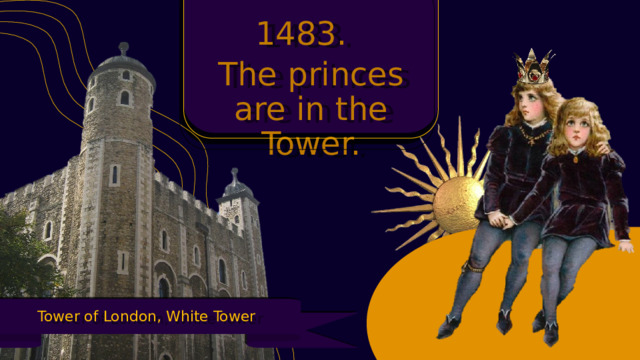 The princes in the Tower
There’s also the ghost angle. Staff at the Tower of London claim to see two small figures in white shirts wandering near the Bloody Tower—which, by the way, got that name after the princes vanished. Creepy, right? But also probably just a guard with a bad torch.
And here’s a surprising fact: the Bloody Tower was originally called the Garden Tower. The name change only happened in the 16th century, after the princes’ story became a best-seller. So basically, it’s the world’s first clickbait rename.
What we actually know
Let’s strip away the drama. We know Edward IV died. We know Richard III took the throne. We know the princes were seen in the Tower garden in mid-1483. After that, zero credible sightings. Did they die? Probably. But how and by whose hand? Your guess is as good as a Tudor astrologer’s.
The most chilling clue? A historian named David Starkey once pointed out that if Richard III did kill the princes, he’d have to be a ruthless, calculating murderer. But if he didn’t, then Henry VII was the one who let the suspicion fester to destroy Richard’s legacy. Either way, someone was a terrible uncle.
So next time you visit the Tower, wave at the ravens and spare a thought for those two little princes. One day, maybe a new document or a piece of DNA will crack the case. Until then, it’s the greatest cold case in British history—and the perfect excuse to argue with your mates over a pint.