So, you’re watching curling, and someone on TV says, “Team Canada has the hammer.” You look at the screen. No one is holding a tool. What gives?
It sounds like something from a construction site, but in curling, the hammer is actually a huge strategic advantage. It’s all about who throws the very last stone of an end.
Think of an end like a single round in a video game. Every stone is a move, but the last move is the most powerful. That’s the hammer.
Must Read
Why Is the Last Stone Such a Big Deal?
Imagine you’re playing chess, but you get two moves in a row at the very end. That’s basically what the hammer does. You get to see every other stone land, and then you get the final say.
With the hammer, you can knock out the opponent’s best stone, slide your own stone into the center, or steal a point at the last second. It’s like having the remote control for the entire end.
Teams fight tooth and nail to earn the hammer. And once they have it, they guard it like a dragon hoards gold.
How Do Teams "Get" the Hammer?
It starts simple: a coin toss or a draw-to-the-button contest before the game. The winner chooses to either have the hammer first or pick the color of their stones. Most pick the hammer.
Here’s the twist. If you score points with the hammer, you lose it for the next end. It’s a trade-off. You score now, but give up control later.
So, sometimes, a team will try to score zero points on purpose. They call this a “blank end.” It’s like saying, “I’ll keep this powerful weapon for another round, thanks.”
 What does the hammer mean in curling scoreboards? | uno
The Coolest Part: Stealing the Hammer
If a team without the hammer manages to score points anyway, that’s called a “steal.” It’s the most exciting moment in curling.
Picture this: you’re playing defense, your opponent has the last stone, and you end up scoring. That’s like stealing the winning goal in soccer just before the final whistle blows.
It feels like a betrayal of physics and strategy. The crowd goes wild, and the team that had the hammer walks away shaking their heads.
How Teams Play With vs. Without the Hammer
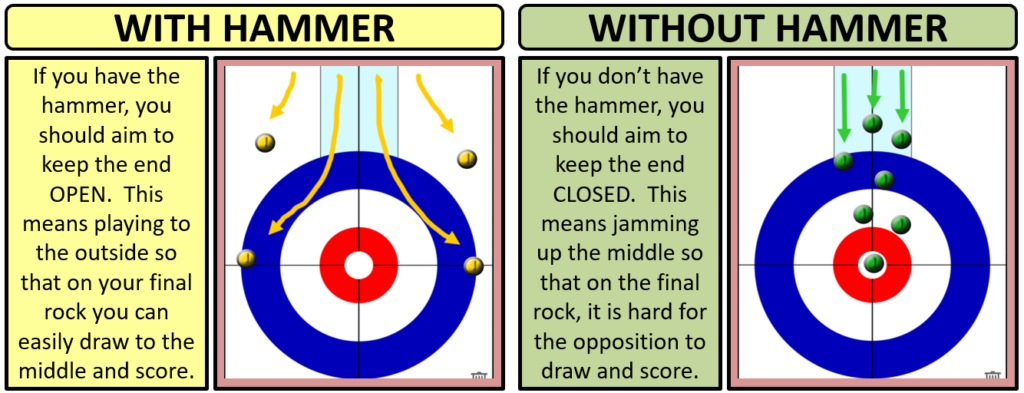
When you have the hammer, you play aggressively. You want to clutter the house (the target) with your stones. You want the final shot to be a simple tap or a heavy hit.
When you don’t have the hammer, you play defensively. You try to scatter the stones, make the house messy, and force the opponent to make a mistake. You’re banking on chaos.
It’s a constant mental game. The team with the hammer wants order. The team without wants a puzzle that’s impossible to solve.
 The hammer in curling explained: What is it and how…
Fun Comparisons to Make It Stick
The hammer is like being the bridesmaid at a wedding. You get to catch the bouquet (or block it) at the very last moment. Or it’s like having the last question in a trivia game—you know exactly what score you need to win.
Ever played basketball and got the last shot of the quarter? That’s the hammer, but with more sweeping and less sweat. It’s the ultimate final word in a conversation made of granite.
Some people compare it to having the Serve in Tennis. But in curling, the “serve” is thrown by the opponent, and you get to return it with a wrecking ball.
So, Is the Hammer Everything?
Not exactly. A great team with the hammer can choke. A scrappy team without it can steal and win. Curling is a game of ice conditions, broom signals, and nerves.
Having the hammer is like having a get-out-of-jail-free card in Monopoly. It’s powerful, but you still need to play the board right. One bad throw, and the hammer turns into a lead weight.
But for fans, it’s the reason why the last five minutes of a curling match are pure adrenaline. You’re watching two minds wrestle, knowing that the hammer will decide whether we see joy or a crushing defeat.
So, next time you hear “hammer,” don’t look for a tool. Look for the team who gets the final word. It’s the coolest secret weapon in sports, hiding in plain sight on a sheet of ice.