Okay, let’s be real for a second. You’ve seen it at the farmer’s market, looking like a tiny, pale-green alien spaceship. Maybe you even bought one on a whim. But now it’s sitting on your counter, and you’re wondering… how in the world do you peel this thing?
Don’t worry, you’re not alone. Kohlrabi can look intimidating with its weird, bulbous shape and those random spindly stems. But here’s the cool part: beneath that rough exterior is a super crisp, sweet, and almost nutty flesh that tastes like a cross between a broccoli stem and a crunchy apple. It’s like a secret treasure chest of flavor, and you just need the key to open it.
So, what’s the trick? It’s actually very simple, and once you get the hang of it, you’ll feel like a total kitchen pro. Ready to crack the code?
Must Read
Step 1: The Great Trim Down
First, grab a sharp chef’s knife. This is not a job for a dull blade—you want clean cuts, folks. Carefully slice off the top and bottom of the kohlrabi, just enough to create flat, stable surfaces.
Now, look at those little stems and leaf stalks. You can cut them off flush with the bulb, or if you're feeling fancy, save the young leaves—they’re totally edible and taste like a milder kale. But for the bulb itself, we want a clean slate.
After that, stand that little green orb up on one of its flat ends. Isn’t it funny how a simple cut makes it look way less alien and more like a weird, upside-down turnip? We’re getting warmer.
Step 2: The Peeling Paradox
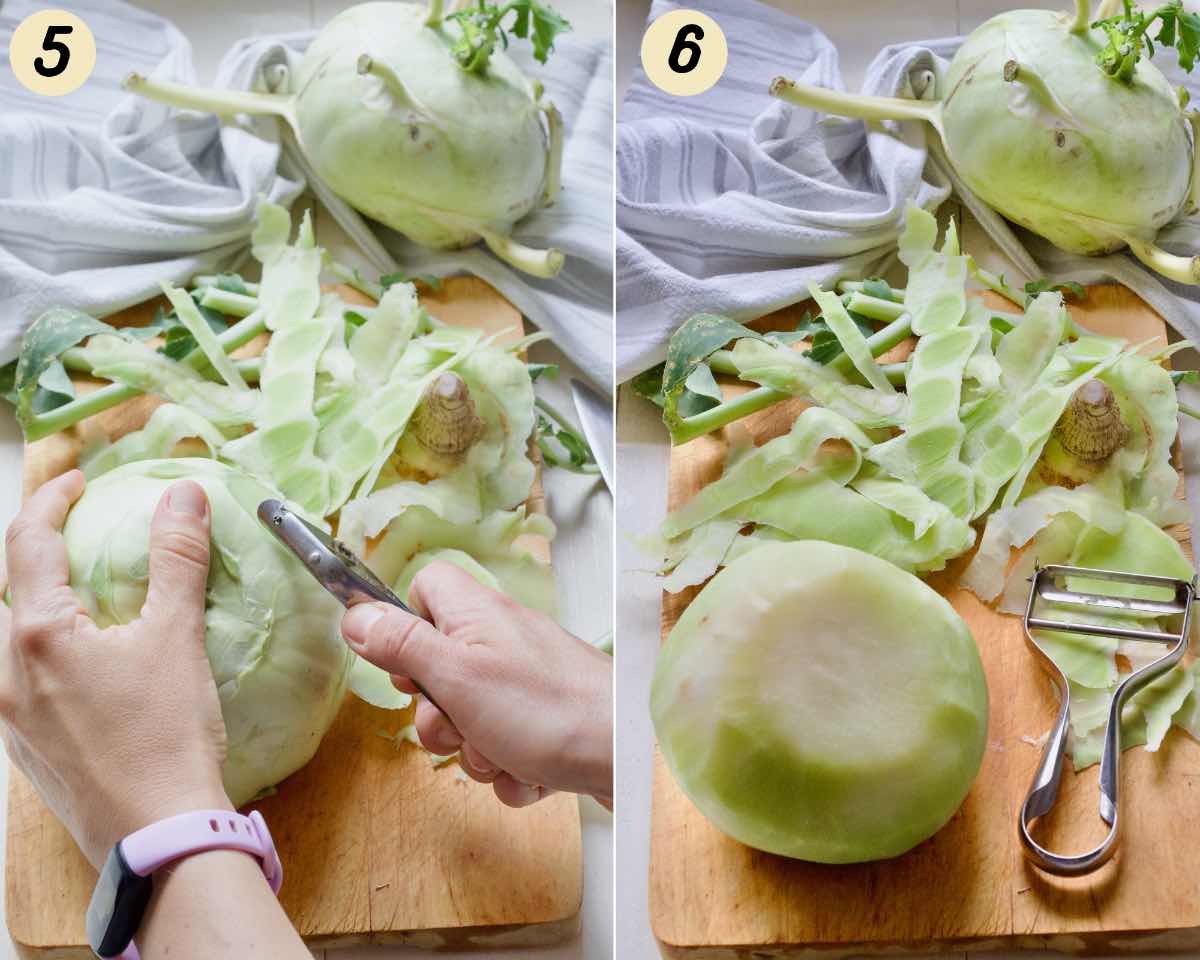
Here’s where the magic happens. Do not try to peel it like a potato with a vegetable peeler. I know, it’s the natural instinct. But that thick, fibrous skin will laugh at your little peeler and make you angry. Trust me, I’ve been there.
 How to Peel Kohlrabi (with Video) - It's a Veg World After All®
Instead, use your knife again. Hold the kohlrabi steady on the cutting board (with a towel underneath if it slides). Starting from the top flat edge, slice downwards, following the curve of the bulb. You’re essentially taking off the skin in thick, vertical strips, just like you’d peel a pineapple or carve a thick piece of wood.
Think of it like this: you’re not skinning a grape; you’re unearthing a pale green jewel from a tough, woody husk. It’s oddly satisfying. You’ll see the dramatic line between the dark green (or purple) skin and the bright, crisp white-green flesh beneath.
Step 3: The "One More Pass" Rule
You might get most of the skin off in one go—great work! But here’s the thing: kohlrabi has a double layer of skin. That outer layer you just sliced off is the tough, fibrous part. But underneath, there’s often a second, slightly more tender but still chewy layer.
Take a look at your peeled bulb. Do you see any darker green or purple streaks left behind? If you do, make a second pass with your knife, shaving off a thinner layer. You want the flesh to be uniformly pale and smooth to the touch.
 How to Cook Kohlrabi - Jo's Kitchen Larder
Why does this matter? Because that inner layer, if left on, can still be a bit woodsy and tough when raw. And why would you settle for tough when you can have pure, crunchy perfection? It’s like taking the papery skin off an onion—a little extra effort, but totally worth it.
Now What? The Fun Part
Give your naked kohlrabi a quick rinse. Look at that! A perfect, pale green sphere. It’s beautiful in its simplicity. You can eat it raw, sliced into coins, or cut into matchsticks for a salad. It’s amazing dipped in salt or a little vinaigrette.
You can also roast it (just toss the chunks in olive oil and salt—heaven), or grate it into a creamy slaw. The possibilities are endless. And the best part? You just learned a skill that makes you look like you know what you’re doing, even if you’re still figuring it out.
A Quick Pro Tip
If you can find purple kohlrabi, grab it! The skin is a gorgeous magenta color, and the reaction when you peel it away to reveal the white flesh is honestly a little bit magical. It’s like watching a flower bloom in reverse.
So go ahead. Buy that weird alien vegetable. Give it a try. You might just discover that peeling it is the most satisfying five minutes of your cooking day. And isn’t it cool that something so strange-looking can be so easy to crack? You’ve got this.